North Dakota's nursing board has done something most boards have not: written practice guidance aimed squarely at drip businesses, with a section from the pharmacy board folded in. It is four pages long and stricter than many operators expect, because it asks for a prescriber's exam before the first bag and another one whenever the plan changes. The market is just as particular. Fargo and Bismarck carry the year-round demand, the Bakken oil field runs on long shifts far from either city, and the drive between towns decides how many visits a nurse can make in a day. Each rule below links to the document behind it. This is background reading; a North Dakota health care lawyer should check your setup before you open. North Dakota is also on our IV therapy rules map, for a side-by-side look at other states.
The nursing board's retail IV guidance
The North Dakota Board of Nursing approved Role of the Licensed Nurse in Retail Intravenous Therapy Settings in December 2024. It names IV hydration clinics, medical spas and mobile IV infusion services, and says the board wrote it after concerns from the public and from other licensing boards. The board adopts guidance like this under NDCC 43-12.1-08(2)(p), and the document says it does not carry the force of law, but it sets out how the board interprets and applies the Nurse Practices Act. The points that shape a mobile business:
- Only a prescriber decides what goes in the bag. The guidance defines a prescriber as a physician, physician assistant or APRN with prescriptive authority.
- Nurses do not pick fluids or doses. It is outside the scope of an RN or an IV-certified LPN to select a medication or solution, set a dosage, or choose the device or its setting for IV hydration, because choosing a dose is part of prescribing (NDAC 54-05-03.1-10).
- Plain hydration still needs an order. An order from a prescriber is required before an RN or IV-certified LPN gives IV therapy, hydration included, and nurses may not independently buy drugs or equipment to do it.
- Standing orders need a relationship behind them. The board says standing orders and protocols are not valid prescriptions without a prescriber-client relationship. A standing order it will accept rests on an initial prescriber assessment, a client-specific plan, and an order for that client's fluids and additives.
- The chart has a minimum. Nurses document the history, the education given on the therapy, the prescriber's informed consent process, vital signs and orders, the procedure and the client's response, any reaction and what was done about it, and aftercare instructions that say when to seek emergency care.
The guidance lists similar documents from Nebraska, North Carolina, South Carolina, Vermont and Wyoming among its references. If you already run under Nebraska's advisory opinion (our Nebraska guide covers it), you will recognize the approach, but write North Dakota protocols against North Dakota's text.
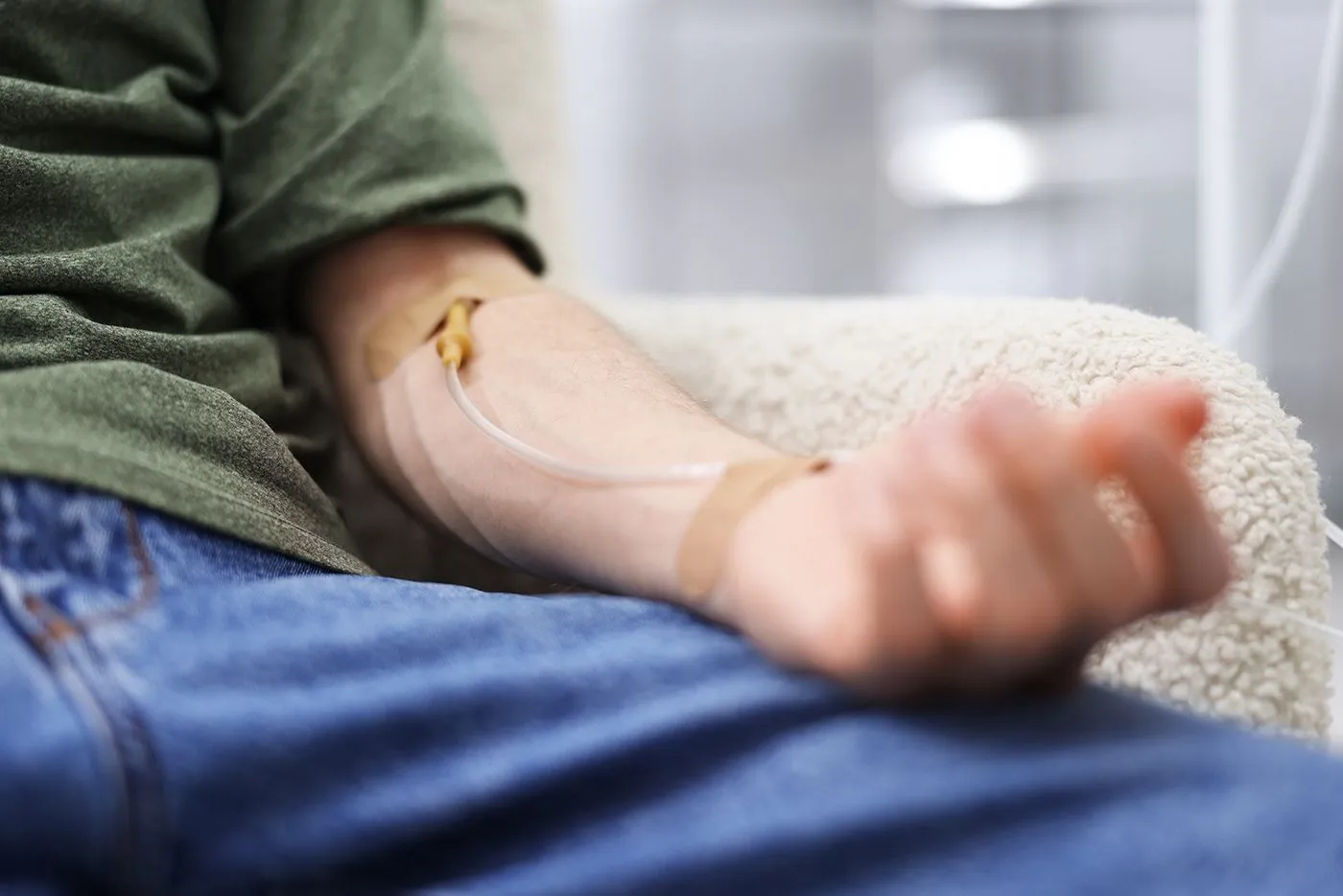
A new exam when the plan changes
The line most operators miss is the second numbered point in the guidance. Prescribers must establish the relationship by performing "an initial, documented history and physical assessment" and building a client-specific plan before any treatment, and the board adds that a "medical clearance" of a client does not meet that requirement. Then it goes further: a change to the treatment plan or the initial order, and it names the type of treatment, the location of treatment, product changes and dosage changes, requires another history and physical by the prescriber before the new plan starts (NDAC 54-05-03.1-03.2, as cited in the guidance).
For a mobile company that is an operating rule, not a footnote:
- A regular who moves from a plain hydration bag to one with an additive needs the prescriber again before the nurse arrives.
- A client seen at home in Fargo who books a hotel visit in Grand Forks next month has, read literally, changed the location of treatment. Ask your lawyer how the board applies that wording to a returning client before you build memberships around it.
- "Build your own bag" menus and upsells at the door do not fit. The nurse cannot add an additive the prescriber has not ordered for that client.
Design the booking form so any change in drip, dose or address sends the client back to the prescriber before dispatch, and price that step openly instead of absorbing it.
Who can own a North Dakota IV company
North Dakota's corporate practice of medicine rule is old and plainly stated. In a 1990 letter opinion, the attorney general wrote that North Dakota public policy prohibits a corporation, other than a professional corporation, from employing physicians, and pointed to the misdemeanor penalty for unlicensed practice in NDCC 43-17-34. The legislature has carved out exceptions rather than drop the rule. NDCC 43-17-42 lets a hospital licensed under chapter 23-16, a nonprofit entity or a charitable trust employ physicians under a written contract that protects the physician's independent judgment. A for-profit IV company is none of those.
- Professional organizations are for licensees. Under the Professional Organizations Act, NDCC chapter 10-31, a professional corporation may issue shares only to people licensed to render the same professional services it was formed for (NDCC 10-31-07), apart from limited exceptions written into the act.
- We found no North Dakota board ruling on lay or nurse ownership of an IV hydration company. The nursing guidance is about what nurses may do, not who holds the shares.
- Clinical decisions stay with the prescriber, whoever owns the company. The guidance puts the plan, the order and the drugs in the prescriber's hands.
Founders without a medical license usually split the business: a professional entity owned by the licensed clinician who evaluates clients, and a management company that owns the brand, vehicles, software and marketing under a written services agreement with flat, documented fees. Have North Dakota counsel draft both sides, and read our post on whether a nurse can own an IV therapy business for the questions to bring.
Who starts the line in North Dakota
Registered nurses
RNs give IV therapy on a prescriber's order. North Dakota defines nursing so that it does not include medical diagnosis or treatment (NDCC 43-12.1-02(5), quoted in the retail IV guidance), so the RN's job at the door is assessment, administration, monitoring and charting, not choosing the drip.
LPNs with IV certification
The board's Role of the LPN in Intravenous Therapy, last revised in July 2022, lets an LPN who has completed board-approved IV education (NDAC 54-05-01-06) manage IV therapy for a stabilized client "under the clinical assignment and supervision" of an RN, APRN or licensed practitioner, in line with facility policy. Within that, an LPN may start and stop peripheral IV fluids, regulate the infusion, and add prescribed medications to IV fluids. An LPN may not give IV bolus medications for moderate sedation, give investigational or cytotoxic drugs, or pull a central line. IV courses are approved before they are first offered and every four years after. A mobile company using LPNs needs written policies naming the supervising RN or APRN for each shift and how that person is reached.
Paramedics and unlicensed staff
North Dakota's paramedic rule, NDAC 33-36-04-02, lists the settings where paramedics practice: an EMS agency, a hospital, or a private company's response team that is not offered to the general public. A drip service sold to the public does not fit that list, and we found no North Dakota ruling that lets paramedics staff elective hydration visits. The nursing guidance names delegation to unqualified individuals as one of the unsafe practices it was written to stop. Put licensed nurses in the chair.
Prescribers and telemedicine
North Dakota APRNs have full practice authority, according to the national NP association's North Dakota fact sheet (updated October 2025). The nursing board's rule on prescriptive authority, NDAC 54-05-03.1-10, lets an APRN with prescriptive authority prescribe, administer, dispense and procure legend drugs, so an NP can be the prescriber of record without a physician partner.
For physicians, NDCC 43-17-44 holds telemedicine to the in-person standard. The licensee must establish a bona fide relationship, verify the patient's identity and disclose their own licensure before diagnosing or treating. The first exam may happen entirely by telemedicine if it is equivalent to an in-person exam: secure video or store-and-forward with the needed peripherals qualifies, as does an exam with a licensed provider in the room. The statute adds that an exam "consisting only of a static online questionnaire or an audio conversation does not meet the standard of care."
The nursing guidance accepts telehealth for the prescriber's assessment, citing NDCC 26.1-36-09.15(1)(g), and says telehealth does not widen what the nurse may do. In practice: book a live video exam with a prescriber licensed in North Dakota before the first drip, chart it in full, and repeat it when the plan changes. OMG can put you in touch with an independent partner medical team that handles this; the good faith exams and medical direction page explains the hand-off.

No clinic license, so the prescriber holds the drugs
The pharmacy board's section of the guidance answers the question every mobile operator asks: who can receive and keep the bags? Its answer is short. Compounding, drug distribution and the equipment used in IV therapy fall under the pharmacy law, NDCC chapter 43-15. Wholesalers must be licensed before doing business in North Dakota and may ship only to authorized individuals. And "given North Dakota does not license clinics, the prescriber(s) must be the responsible party for receipt and storage of these legend drugs under their control." IV fluids are legend drugs, so the bag in the nurse's kit belongs, legally, to a prescriber's supply.
- Mixing follows USP 797. The guidance says the USP standard is legally required for compounding in North Dakota and that chapter 797 applies to all prescribers and personnel who prepare sterile preparations such as IV therapies. The pharmacy board's compounding standards rule tells compounders to follow USP chapter 797 (NDAC 61-02-01-03).
- Immediate use is narrow. The immediate-use exception in USP 797 is "very limited," and one condition the board highlights is that a preparation involve no more than three different sterile products.
- Dispensing is not the same as giving a drip. North Dakota exempts physicians who supply their own patients' immediate needs, such as a seventy-two-hour supply, from parts of the pharmacy law (NDAC 61-04-02-01), but that exemption is about handing patients medication, not about stocking a fleet.
Set the wholesale account in the prescriber's name, keep stock where the prescriber controls it, and log what goes out in each kit and what comes back. We found no North Dakota rule written about leaving IV stock in a vehicle overnight; ask the Board of Pharmacy before your nurses do it, especially in a winter when a car can freeze a bag solid.
What North Dakota licenses, and what it skips
- The business: the pharmacy board says in the retail IV guidance that North Dakota does not license clinics. There is no IV hydration facility license to apply for, even though every clinician and every drug involved is regulated.
- Home health: under NDCC chapter 23-17.3, nobody may run a home health agency without a license from the Department of Health and Human Services, and home health services must include a registered nurse and at least one other therapeutic service. A hydration-only visit may fall outside that definition, but we found no department statement on IV hydration. Ask the Health Facilities Unit before you advertise broader in-home nursing.
- Paying for referrals: the physician discipline statute, NDCC 43-17-31(1)(r), covers "the payment or receipt, directly or indirectly, of any fee, commission, rebate, or other compensation" for patient referrals. Leave hotel desks, crew camps and gyms a card with your booking link, earn their recommendations with on-time arrivals and good care, and ask a North Dakota health care lawyer before offering anyone money or a perk for sending clients.
- New laws: we found no North Dakota statute or bill written specifically for IV hydration businesses. For now the guidance, the practice acts and the pharmacy rules are the framework.
North Dakota agencies to bookmark
| Agency | Why a mobile IV operator needs it |
|---|---|
| North Dakota Board of Nursing | The retail IV guidance, LPN IV therapy rules and course approval, APRN prescriptive authority |
| North Dakota Board of Medicine | Physicians and PAs, the telemedicine standard in NDCC 43-17-44, discipline for referral fees |
| North Dakota Board of Pharmacy | Wholesaler licensing, compounding and USP 797, where prescribers keep legend drugs |
| Health and Human Services, Health Facilities Unit | Home health agency licensing under chapter 23-17.3 and its rules, chapter 33-03-10.1 |
| North Dakota Secretary of State | Forming the professional organization and the management company |
Fargo, Bismarck and the oil patch
North Dakota counted 799,358 residents on July 1, 2025. The figures below come from the Census Bureau's 2025 metro, county and city estimates.
| Area | Residents | Playbook |
|---|---|---|
| Fargo metro (Fargo, West Fargo, Moorhead) | 269,528 | The state's largest base: Fargo 136,275 and West Fargo 41,175, plus NDSU. Moorhead and Clay County (67,734) are in Minnesota, so check licensing in both states before you serve them |
| Bismarck-Mandan metro | 139,750 | The capital, with Bismarck 77,963 and Mandan 25,061; the natural base for trips west toward Dickinson and Medora |
| Grand Forks metro | 105,046 | UND's campus city (Grand Forks 60,365); East Grand Forks and Polk County sit in Minnesota |
| Minot metro | 75,694 | Minot city 47,308 and the State Fair each July; a few set days a week usually covers it |
| Williston and Dickinson areas | 41,767; 39,142 | Oil country: Williston 29,522, Dickinson 25,870, and McKenzie County (15,192, home of Watford City) between them. Crews on rotation, booked around shifts |
The oil patch is a different customer from Fargo. The Department of Mineral Resources' Director's Cut of September 21, 2026 put July production at 1,156,641 barrels a day, about 34% of it from McKenzie County and 97.6% from the Bakken and Three Forks formations, with 34 rigs and 9 frac crews working. Those are long shifts in heat and hard cold, with crews living in Williston, Watford City and Dickinson between rotations. Sell what is true: a licensed nurse who comes to the crew house after a shift, a clear price, and a booking window that fits a rotation. Do not pitch a drip as a fix for fatigue, heat or anything else, and say plainly that confusion, chest pain or trouble breathing call for emergency care, not an IV. Run separate pages, profiles and ad groups for Fargo, Bismarck and the oil counties; that split is how we set up mobile IV therapy marketing for a brand covering more than one North Dakota market.
Long drives, short summers
Fargo sits on the Minnesota line and Williston near Montana, and the larger cities are hours apart across open prairie. A nurse based in Fargo cannot also cover Williston the same day, and a winter storm can close the road between them. Plan service areas around where nurses actually live, list only the towns you reach on time, and say on the page which days you visit the smaller ones.
Tourism is real but seasonal. North Dakota's Commerce Department reported 25.6 million visitors in 2025, down 2.6%, who spent $3.4 billion, down 1.2%; Canadian border crossings fell 23.9%. The same release counted Theodore Roosevelt National Park visits up 27.3% year to date through April 2026. The park's monthly counts show the curve: the National Park Service recorded 729,893 recreation visits in 2025, including 155,747 in July and 151,582 in August, against 850 in January. Medora, the gateway town, has 157 residents. Summer visitors to the Badlands are worth a page for Medora and Dickinson; winter belongs to residents.

When North Dakota books up
- The school year: the North Dakota University System's fall 2025 report counted 15,844 students at UND and 11,952 at NDSU, out of 47,522 system-wide. Move-in, football Saturdays and graduation bring parents to Grand Forks and Fargo.
- Late May in Fargo: the Fargo Marathon runs May 21-22, 2027. Stick to convenience and booking ease in race copy, never performance or recovery claims.
- June to September in the Badlands: park visits climb from May (77,061 in 2025) through a July peak and stay high in September (127,296).
- Late July in Minot: the North Dakota State Fair runs July 23-31, 2027.
- All year in oil country: rigs and frac crews work through the winter, so the oil counties do not follow the tourist calendar.
When a North Dakota guest asks an AI assistant
A rotation worker landing in Williston or a family driving to Medora often asks a chatbot who comes to them before they search. The businesses it names tend to be the ones whose pages state plain facts: which towns you reach and on which days, the price of each drip, the arrival window, and that a North Dakota-licensed prescriber reviews every client before the first bag and again when the plan changes. Repeat those facts word for word in your Google Business Profile and directories, so nothing contradicts them.
North Dakota IV operator FAQ
Does North Dakota license IV hydration businesses?
No. The pharmacy board's section of the nursing board's retail IV guidance says North Dakota does not license clinics, which is why it makes the prescriber responsible for receiving and storing the drugs. The nurses, prescribers, wholesalers and drugs are all regulated.
Can a North Dakota nurse start an IV from a standing order?
Only when a prescriber-client relationship stands behind it. The board says a valid standing order rests on an initial prescriber assessment, a client-specific plan and an order for that client's fluids and additives. A general order for anyone who walks in does not qualify.
Does a client need a new exam to switch drips?
Under the guidance, yes. A change in the type of treatment, the location, the product or the dose needs another history and physical by the prescriber before the new plan starts. Build that step into rebooking.
Can LPNs start hydration IVs in North Dakota?
Yes, after board-approved IV education, for a stabilized client, under the clinical assignment and supervision of an RN, APRN or licensed practitioner. LPNs still cannot choose the fluid or the dose.
Can a nurse practitioner be the prescriber?
Yes. North Dakota APRNs with prescriptive authority practice without a physician agreement and may prescribe, procure and administer legend drugs. They are held to the same exam and plan requirements as physicians in the guidance.
OMG and this North Dakota guide
For context: OMG Marketing Co is a Goodyear, Arizona-based agency built around mobile IV therapy. Our founder, Joseph Lopez, built a mobile IV company in Arizona to about $10 million a year before starting OMG, and today we run marketing for multi-state brands like Pure IV. To date we have worked with 50+ IV operators, helped drive $100M+ in client revenue, supported 200,000+ patient dispatches since we started, and booked 100,000+ appointments through our marketing. We are an AmSpa Platinum Vendor.
What we do for mobile IV operators
- SEO and Google Business Profile management
- Paid media (Google Ads, Meta, programmatic)
- Web design and CMS work
- Content marketing and editorial production
- Dispatch operations and software guidance
- Hiring and recruiting for nurses and operations roles
- Medical Direction, through an independent partner medical team
- Good Faith Exams for new patient onboarding, through an independent partner medical team
- Operator-to-operator consulting
North Dakota's retail IV guidance is a board document, not a statute, and boards revise their guidance, so reopen each linked source before you act. If Fargo, Bismarck or the oil patch is on your list, we would be glad to map it out with you.
Medical services, including medical direction, protocols and good faith exams, are provided by independent licensed providers, not by OMG Marketing. OMG Marketing does not practice medicine.