OMG Marketing / Telehealth / Peptides
Peptide therapy marketing Teach first. Claim only what you can prove.
Search and content for clinics that offer peptides, online or in person. Education pages that build trust, careful wording that keeps your ad and search accounts in good standing, and no promises about what a peptide treats.
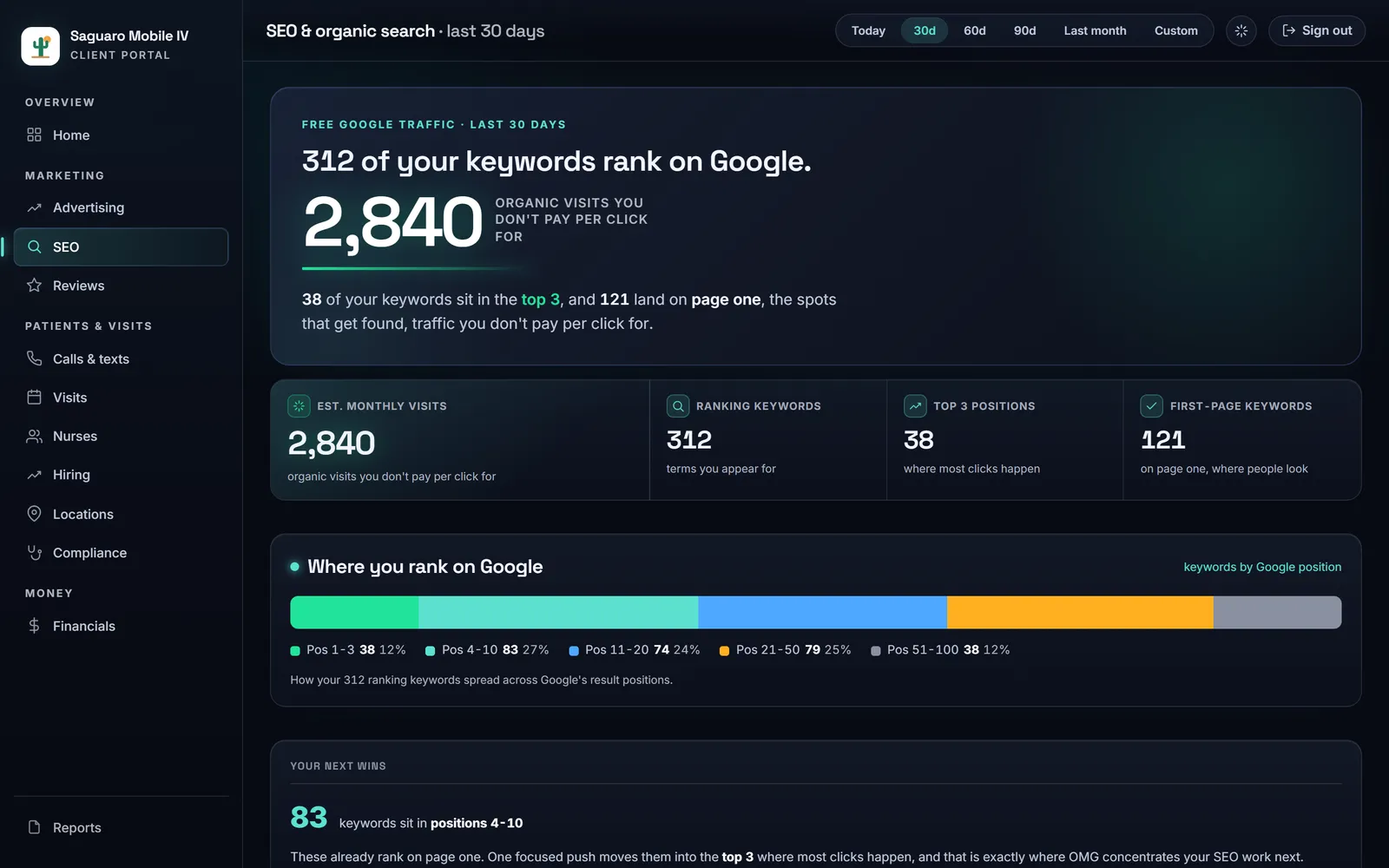
- keywords on page one of Google for Revive Mobile IVs
- 575
- keywords Revive ranks for in all
- 3,412
- official rule pages from Google, Meta and the regulators, linked below
- 11
Who it’s for
Clinics that teach before they sell.
People who search for peptides read a lot before they call. We market the program wherever the visit happens, with the education up front.
Telehealth
Online wellness programs
Education-first pages and search, state by state, where your providers are licensed.
In person
Clinics and med spas
Local search and content that explain what you offer, and who decides whether it fits: your provider.
Mobile IV
Peptides next to IV therapy
A separate set of pages and campaigns with its own rules, kept apart from your IV marketing.
How IV, GLP-1s and peptides fit in one business: the free Academy →What’s different
Peptides change what you can say.
The same search and content we run for every client, with six things that change when the subject is peptides.
- The FDA is still deciding.The FDA lists several peptides as compounding substances that may present significant safety risks, and in July 2026 its advisory committee reviewed others, including BPC-157 and TB-500. No final decision has been published.
- Google calls much of it experimental.Google doesn’t allow ads promoting speculative or experimental medical treatments, and limits prescription drug terms. Plan for ads to be limited; search and education pages carry the load.
- “Research use only” is no cover.In a March 2026 warning letter, the FDA rejected that label on peptides sold with weight loss claims and treated them as unapproved new drugs.
- Teach, don’t promise.Pages that explain what a peptide is, how your providers decide who it suits and what the research does and doesn’t show earn trust. A claim that it heals, burns fat or reverses aging needs scientific evidence behind it.
- Your provider decides, on every page.Every page says the same thing in plain words: a licensed provider decides whether anything is right for you.
- Patients research quietly.They read for a long time before they call. Search and content meet them early, so your clinic is the name they know when they’re ready.
The ad rules
What you can say, and where.
The rules for peptide ads on Google and Meta, and for the claims on your pages, in one place. Every rule links to the official page it comes from.
Before the first ad
LegitScript certification
Google and Meta both require it for telehealth providers and online pharmacies. Its standards bar facilitating medications regulators consider unapproved. LegitScript lists $975 per website to apply.
LegitScript: Healthcare CertificationGoogle certification
In the US, Google allows telemedicine providers accredited by LegitScript, and advertisers must also be certified with Google before prescription drug terms can run.
Google: Healthcare and medicinesMeta authorization
Meta needs active LegitScript certification and its own written permission. Prescription drug ads target people 18 or older, in the US, Canada or New Zealand only.
Meta: Drugs and pharmaceuticals
- Not allowedSpeculative or experimental treatments
Google doesn’t allow ads that promote them, whatever the landing page says.
- Approval firstPrescription drug terms
Restricted in ads, landing pages and keywords to advertisers certified with LegitScript and Google.
- Not allowedRemarketing for injections
Injections and treatments for health conditions are sensitive categories: no remarketing lists, Customer Match or lookalikes.
- AllowedRanking in search
Organic search isn’t an ad: education pages that rank for what people type carry most of the load.
Meta
Facebook, Instagram- Not allowedAnything Meta calls unsafe
No “unsafe substances, products or supplements, as determined by Meta at its sole discretion.”
- Approval firstTelehealth and prescription ads
Active LegitScript certification and Meta’s written permission, aimed at people 18 or older.
- Not allowedLines about the reader’s health
Ads can’t assert or imply a health condition about the person reading. Meta’s own example of a banned line: “Do you have diabetes?”
- Not allowedHealth data in forms and the pixel
Lead forms can’t ask for health information without Meta’s permission, and its business tools terms bar sending health information through the pixel.
FDA & FTC
Your pages and claims- Red flagPeptides on the FDA’s risk list
The FDA names ipamorelin, GHRP-2, GHRP-6, ibutamoren and kisspeptin-10 among bulk substances that may present significant safety risks in compounding.
- Check firstBPC-157, TB-500 and others under review
The FDA’s compounding advisory committee reviewed them in July 2026. No final decision had been published when we checked.
- Not allowed“Research use only,” sold to people
The FDA rejected the label in a March 2026 warning letter and treated the peptides as unapproved new drugs.
- Allowed, with proofEducation with evidence
What a peptide is, what studies show and don’t, and that a provider decides. A health claim needs competent and reliable scientific evidence.
Say this, not that
Not this“Heals injuries twice as fast.”
Say this“What the research on this peptide does and doesn’t show.”
Not this“Melts fat while you sleep.”
Say this“Ask a licensed provider whether peptide therapy fits your goals.”
Not this“Reverse aging.”
Say this“Our providers explain the options, and their limits.”
Not thisCalling a peptide FDA-approved when it isn’t.
Say this“Not FDA-approved for this use,” whenever that is the truth.
Checked against the official pages on Oct 20, 2026. This is how we plan campaigns, not legal advice: your medical and legal team signs off.
How we run it
Education that ranks, then the booked visit.
SEO
Education and program pages that rank for what people type while they research, local or state by state.
SEO →Content
Pages, video and email that teach, reviewed by your providers before anything goes live.
Content →Paid ads
Where the rules allow it: campaigns for the clinic and the consult, checked against the current policies first.
Paid ads →Websites & funnels
Pages that are fast on a phone, with HIPAA-compliant forms for the intake.
Websites →Calls answered
For in-person and mobile programs, real people answer as your business and book the visit.
Answering service →Your own portal
Rankings, leads and what each patient cost, live, with your logo on it.
Client reporting →Medical decisions stay with licensed providers. We market the program. Whether a peptide is right for someone is your providers’ call, and for mobile IV and med spa visits we connect you with an independent partner medical team for good faith exams.
How the partner team works →Medical services, including medical direction, protocols and good faith exams, are provided by independent licensed providers, not by OMG Marketing. OMG Marketing does not practice medicine.
The proof
Real accounts, real results.
Our published case studies are mobile IV brands, and they are labelled that way below. Telehealth brands, including Direct Care Telehealth, get the same search, content and reporting.
 Mobile IV · Pennsylvania575
Keywords on page one of Google.
Read the case study → Mobile IV · Tulsa, OK1,636
Booked appointments in the case study, from paid search, local search and landing pages.
Read the case study → Mobile IV · TN, Carolinas, GA, TX3,129
Google Ads conversions, September 2025 to August 2026.
Read the case study →Questions
Peptide marketing, answered.
Can we run Google Ads for peptide therapy?
Within tight limits. Google does not allow ads promoting speculative or experimental medical treatments and restricts prescription drug terms, so search and education pages usually carry the load. We check each campaign against the current rules before it launches.
Can we advertise peptides on Facebook and Instagram?
Meta can reject any substance it considers unsafe, at its sole discretion, and telehealth providers need LegitScript certification. Content that teaches, rather than sells, stands the best chance.
What can our pages say about results?
What the evidence supports, and that a licensed provider decides whether a peptide is right for someone. A claim that a peptide treats a condition needs competent and reliable scientific evidence.
Do you write the medical content?
We write and build the pages; your licensed providers review and sign off on anything medical. OMG Marketing does not practice medicine.
Do you work with telehealth and in-person clinics?
Both: online programs marketed state by state where your providers are licensed, and clinics, med spas and IV brands marketed to their own area.
How will I know it’s working?
Every client gets a portal with their own logo on it: search rankings, leads, ad spend and what each patient cost, live, any time.
Let’s grow yours.
Tell us where you are and where you want to be. We’ll show you what we’d change first.
Apply for your strategy Not open yet? The Mobile IV Therapy Academy is free →