OMG Marketing / Telehealth / TRT & hormones
TRT & hormone clinic marketing Patients research for weeks. Be the clinic they book.
Search, content and ads for testosterone and hormone programs, online and in the clinic. Built around the rules for a controlled substance: what Google and Meta allow, what the label says, and where telehealth prescribing stands.
- in Google Ads managed for clients, last 12 months
- $2.4M
- conversions from one ad account we ran for five years
- 73,637
- official rule pages from Google, Meta and the regulators, linked below
- 13
Who it’s for
Online programs and clinic doors.
Hormone patients read, compare and wait before they book. We market the program wherever the visit happens.
Telehealth
Online TRT and hormone programs
Marketed state by state to where your providers are licensed, with intake that answers the questions about labs, follow-ups and refills before the form.
In person
Men’s health and hormone clinics
Local search, maps and ads that bring people to your door, with a page for every program you run.
Med spas & IV
Hormones as a separate program
Its own pages, its own campaigns and its own approvals, kept apart from the rest of your marketing.
What’s different
A controlled substance changes the marketing.
The same search, ads and funnels we run for every client, with six things that change for testosterone.
- The prescribing rules have a date on them.Testosterone is Schedule III. Telehealth prescribing of controlled substances runs on DEA flexibilities extended through December 31, 2026, with no permanent rule published yet. The marketing plans for both outcomes.
- The label is moving.Testosterone is approved for men with low testosterone caused by a medical condition. The FDA changed the class labelling in 2025 and, in June 2026, asked for more changes, including the limit on age-related low testosterone. Pages follow the current label.
- Patients research for weeks.Search and content meet them early: how a program works, how labs and follow-ups run, what it costs. The clinic that answered first is the one they book.
- No “Low T?” headlines.Meta bans ads that assert or imply a health condition about the reader, and Google won’t let health ads use your remarketing lists or lookalikes. The ad talks about the clinic, not the reader’s body.
- Steroids and hCG are red lines.Google lists hCG promoted alongside anabolic steroids as an unapproved substance. Bodybuilding language stays out of the account entirely.
- Approvals come first.Prescription and telehealth ads on Google and Meta need LegitScript certification and each platform’s own approval before launch.
The ad rules
What you can say, and where.
The rules for testosterone and hormone ads on Google and Meta, and for the claims on your pages, in one place. Every rule links to the official page it comes from.
Before the first ad
LegitScript certification
Google and Meta both require it for telehealth providers and online pharmacies. LegitScript lists $975 per website to apply and $2,150 a year per website once certified.
LegitScript: Healthcare CertificationGoogle certification
In the US, Google allows telemedicine providers accredited by LegitScript, and advertisers must also be certified with Google before prescription drug terms can run.
Google: Healthcare and medicinesMeta authorization
Meta needs active LegitScript certification and its own written permission. Prescription drug ads target people 18 or older, in the US, Canada or New Zealand only.
Meta: Drugs and pharmaceuticals
- Approval firstPrescription and telehealth ads
Only for LegitScript-accredited advertisers who are also certified with Google. Drug names in ads, keywords and landing pages are restricted until then.
- Not allowedhCG with anabolic steroids
On Google’s list of unapproved substances, whatever the claims of legality.
- Not allowedRemarketing, Customer Match, lookalikes
Sexual health, health conditions and injections are sensitive categories. Google’s own audiences still work; yours don’t.
- AllowedAds for the clinic and the visit
The provider visit, the labs, the program and its price, as long as the ad and the page stay inside the drug-term rules above.
Meta
Facebook, Instagram- Approval firstPrescription drug ads
Active LegitScript certification and Meta’s written permission, aimed at people 18 or older in the US, Canada or New Zealand.
- Not allowed“Low T?” and lines like it
Ads can’t assert or imply a health condition about the person reading. Meta’s own example of a banned line: “Do you have diabetes?”
- Not allowedAnything Meta calls unsafe
No “unsafe substances, products or supplements, as determined by Meta at its sole discretion.”
- Not allowedHealth data in forms and the pixel
Lead forms can’t ask for health information without Meta’s permission, and its business tools terms bar sending health information through the pixel.
DEA, FDA & FTC
Prescribing and claims- Check firstTelehealth prescribing of testosterone
A Schedule III drug. The DEA’s telehealth flexibilities run through December 31, 2026. Your providers decide; the ads never promise a prescription.
- Not allowedPromises beyond the label
Testosterone is approved for men with low testosterone caused by a medical condition. Energy, muscle or anti-aging promises are claims you would have to prove.
- Allowed, with proofResults and testimonials
Claims need competent and reliable scientific evidence. A standout result must show what a typical patient can expect; “results not typical” doesn’t cover it.
- Not allowedFake or bought reviews
Banned under the FTC’s reviews and testimonials rule since October 21, 2024.
Say this, not that
Not this“Low T? Get your testosterone today.”
Say this“Talk to a licensed provider about hormone testing.”
Not this“TRT online, no visit needed.”
Say this“Online visits with a licensed provider in your state.”
Not this“Feel 20 again. Build muscle fast.”
Say this“What testosterone therapy is approved for, explained by our providers.”
Not thisOne patient’s best result, on its own.
Say thisHis result, real and with permission, next to what a typical patient can expect.
Checked against the official pages on Oct 20, 2026. This is how we plan campaigns, not legal advice: your medical and legal team signs off.
How we run it
From the first search to the booked visit.
SEO
Program, provider and state pages that rank for what hormone patients type while they research.
SEO →Paid ads
Google and Meta campaigns built on the approvals above, aimed at the states you serve, tuned to booked visits, not clicks.
Paid ads →Websites & funnels
Intake funnels that are fast on a phone, with HIPAA-compliant forms.
Websites →Content
Education pages, video and email that answer the long research before anyone books.
Content →Calls answered
For in-person and mobile programs, real people answer as your business and book the visit.
Answering service →Your own portal
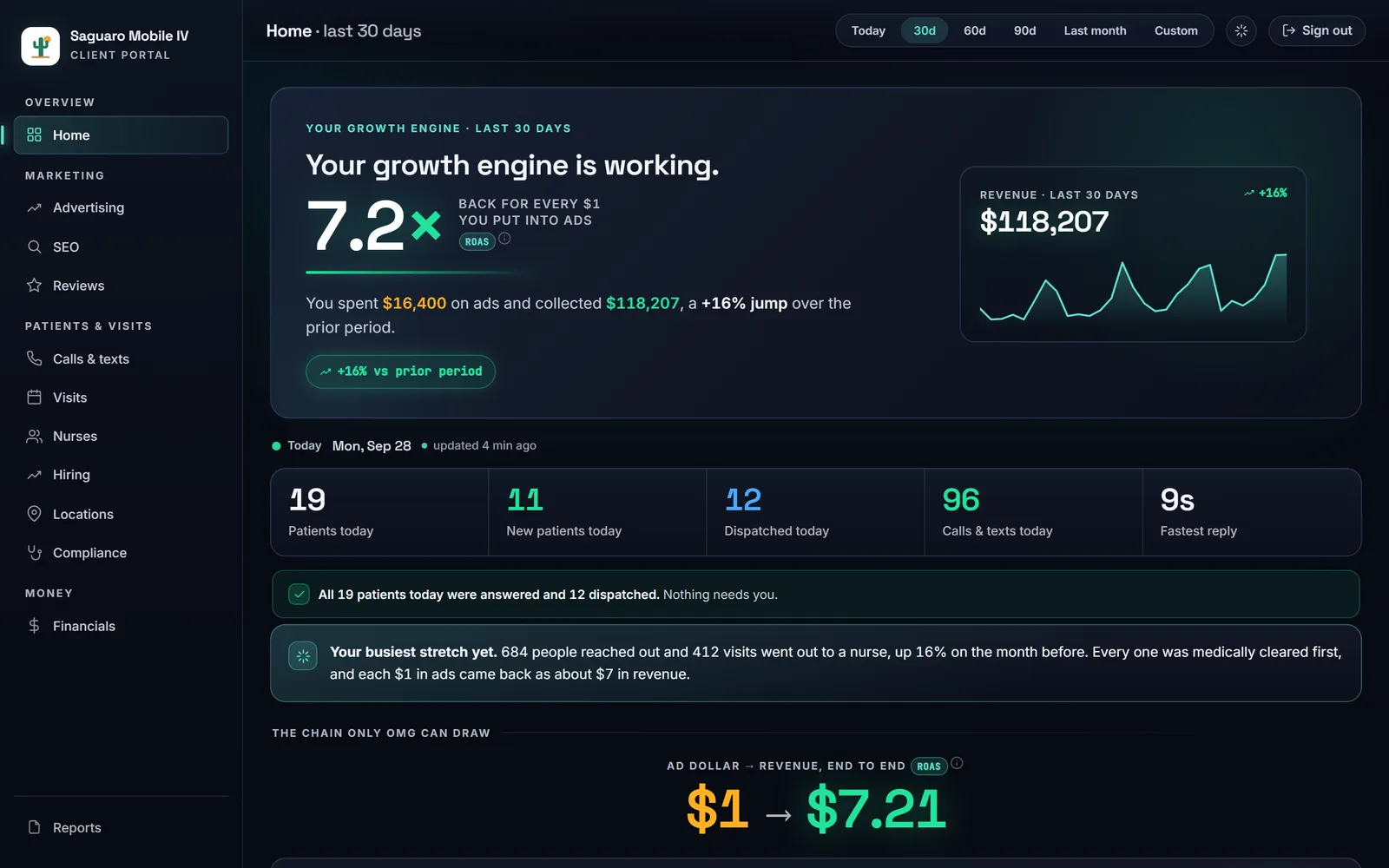
Spend, leads, rankings and what each patient cost, live, with your logo on it.
Client reporting →Medical decisions stay with licensed providers. We market the program. Prescribing is your providers’ call, and for mobile IV and med spa visits we connect you with an independent partner medical team for good faith exams.
How the partner team works →Medical services, including medical direction, protocols and good faith exams, are provided by independent licensed providers, not by OMG Marketing. OMG Marketing does not practice medicine.
The proof
Real accounts, real results.
Our published case studies are mobile IV brands, and they are labelled that way below. Telehealth brands, including Direct Care Telehealth, get the same search, ads and reporting.
 Mobile IV · Pennsylvania17.15%
Click-to-conversion rate over 12 months, against a category benchmark around 10%.
Read the case study → Mobile IV · TN, Carolinas, GA, TX3,129
Google Ads conversions, September 2025 to August 2026.
Read the case study → Five years, one accountArizona · name withheldMobile IV · Google Ads$63.39Blended cost per conversion across $4.67M of ad spend in one account.
Read the case study →Questions
TRT marketing, answered.
Can you run Google and Meta ads for a TRT clinic?
Yes, within the rules. Prescription and telehealth ads need LegitScript certification and each platform’s own approval, and the ads talk about the clinic and the visit, never about the reader’s body. Your medical and legal team signs off.
Can patients start TRT online?
That is your providers’ decision under federal and state law. Testosterone is a Schedule III controlled substance, and the DEA’s telehealth flexibilities for prescribing controlled substances are extended through December 31, 2026. We keep the ads and pages from promising a prescription.
Why can’t our ads say “Low T?”
Meta does not allow ads that assert or imply a health condition about the person reading them. The ad talks about the clinic, the provider and the visit instead.
What can our pages say testosterone does?
What the label and the evidence support, written with your providers. The FDA changed testosterone labelling in 2025 and asked for more changes in June 2026, so the pages are checked against the current label.
Do you prescribe or provide the medical side?
No. Prescribing and medical decisions stay with licensed providers. OMG Marketing does not practice medicine.
How will I know it’s working?
Every client gets a portal with their own logo on it: ad spend, leads, search rankings and what each patient cost, live, any time.
Let’s grow yours.
Tell us where you are and where you want to be. We’ll show you what we’d change first.
Apply for your strategy Not open yet? The Mobile IV Therapy Academy is free →