North Carolina gives nurses more room than South Carolina does and gives owners less. Its nursing board lets RNs and LPNs give IV hydration on a prescriber's individualized order, with no prescriber on site for the RN, while its medical board says any business that practices medicine must be owned entirely by North Carolina licensees and bars licensees from sharing revenue by percentage with anyone who is not one. Add $37.2 billion in visitor spending in 2025 and a Charlotte metro of nearly 3 million people, and the company structure decides who gets to compete. Each point below links to the document behind it. This is background reading; a North Carolina health care lawyer should check your setup before you open. North Carolina is also on our IV therapy rules map, for a side-by-side look at other states.
North Carolina's ownership rule comes first
The North Carolina Medical Board's position statement on the corporate practice of medicine (adopted March 2016, amended September 2025) says businesses practicing medicine in the state "must be owned in their entirety by persons holding active North Carolina licenses." The owners must be the board's licensees or one of the combinations allowed by G.S. 55B-14. What follows from that:
- Licensees carry the risk. A physician, PA or other licensee who works for a non-compliant business may be disciplined, and being an employee or an independent contractor does not settle the question.
- Lay owners can be stopped. The board says it may seek injunctive relief against lay owners of a business engaged in the corporate practice of medicine. Its exceptions are hospitals, HMOs, public health clinics and charitable nonprofits, none of which describes a drip company.
- Mixed-license owners have a list. G.S. 55B-14(c) lets a professional corporation combine, for example, a physician with physician assistants, or a physician with nurse practitioners, clinical nurse specialists or certified nurse midwives.
- No revenue share. The board's statement on referral fees and fee splitting (amended September 2021) says "a licensee cannot share revenue on a percentage basis with a non-licensee," calling it fee splitting and grounds for discipline.
So the usual answer for a lay founder is two companies: a professional entity owned by licensees that makes every clinical decision, and a management company the founder owns that runs marketing, scheduling, vehicles and supply purchasing under a written management services agreement. In North Carolina those management fees should be flat and set at fair market value, never a cut of revenue. Our Charlotte guide walks through that setup step by step; have North Carolina counsel draft both sides.
Nurses have their own ownership line. The nursing board says an RN may set up an independent nursing business, PC or PLLC (with orders from a prescriber for the IV work) and should get legal advice first, and that "LPNs are not authorized to own professional nursing businesses, in full or in part, under NC law."
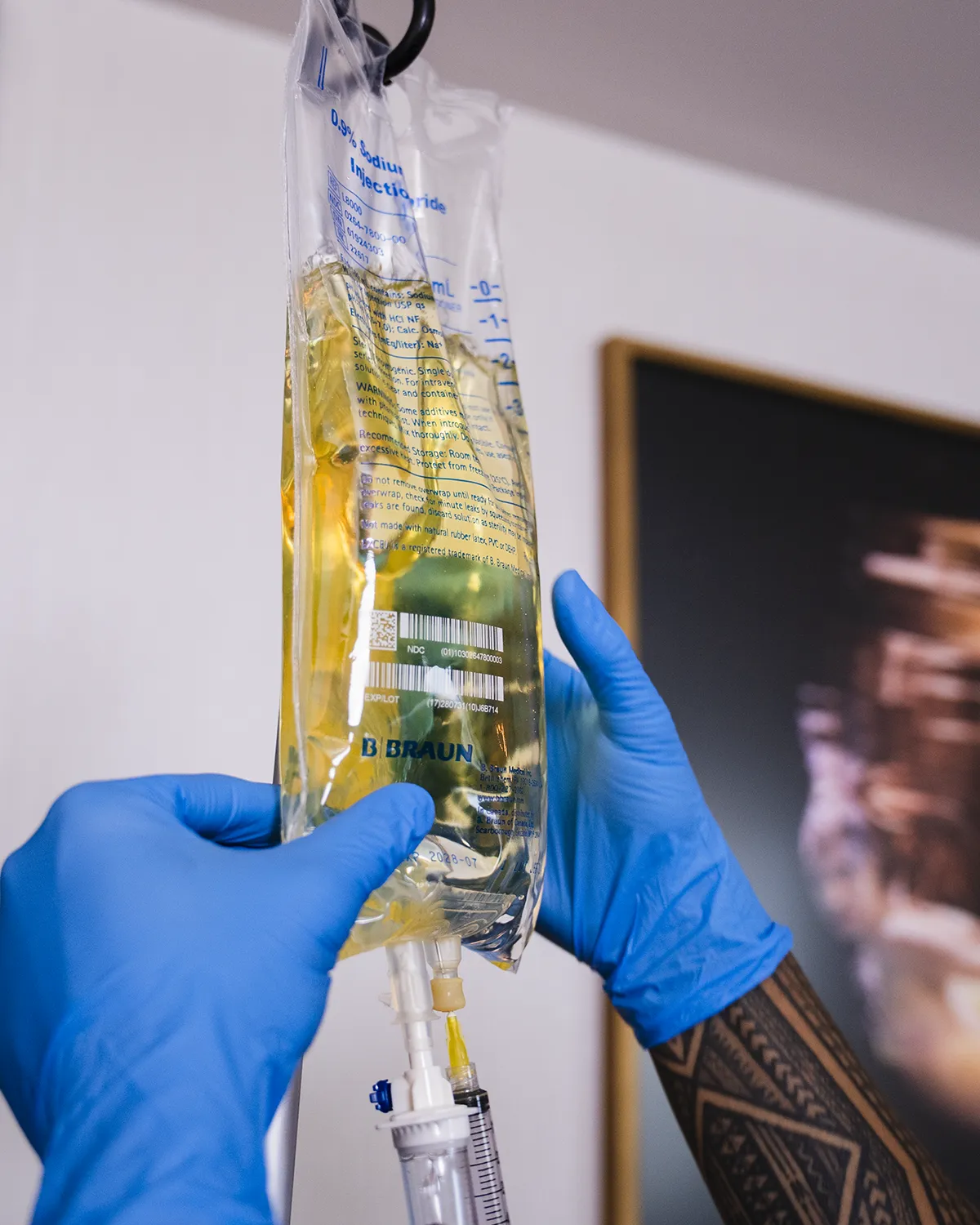
Who hangs the bag in North Carolina
The North Carolina Board of Nursing's position statement Administration of Intravenous Fluids (IV Hydration), Nutrient Therapies, and Medications for Hydration, Health, and Wellness (origin 9/2022) is written for walk-in and mobile hydration clinics and drip bars. It says giving IV hydration, nutrient therapies and medications is within RN and LPN scope when authorized by a valid order from a physician, NP, PA or other licensed practitioner with prescriptive authority. The board notes that a position statement does not carry the force of law, but it is how the board tells nurses it expects them to practice.
Registered nurses
"The RN does not require the on-site presence of a physician, NP, PA, or other licensed health care practitioner" to give the ordered therapy. Before starting, the nurse must have an individualized prescription or order from a prescriber and must have completed a client evaluation for procedure appropriateness. The RN is accountable for recognizing side effects, toxic and allergic reactions and changes that mean the infusion should stop, and for deciding what to do when they happen. The business must keep policies and procedures on site for IV administration and emergency interventions.
LPNs
An LPN participates as assigned and needs supervision by an RN, physician, NP, PA or other prescriber; under appropriate supervision, the LPN may give ordered IV hydration, nutrient therapies and medications. The statement does not say whether that supervisor must be on site during a home visit. Settle it in writing with your ordering provider and counsel before an LPN goes out alone.
Paramedics and unlicensed staff
The nursing board's statement covers RNs and LPNs only. Paramedics in North Carolina are credentialed by the state health department, through its Office of EMS (G.S. 131E-155), and we found no North Carolina ruling that addresses paramedics running elective hydration visits outside an EMS system. Ask the Office of EMS and your lawyer before you schedule a paramedic for a drip visit, and default to nurses in the meantime.

Prescribers and the first exam
The medical board's statement on contact with patients before prescribing (amended July 2024) expects a history, a physical exam, a working diagnosis and a treatment plan, all documented, and calls prescribing for someone the prescriber has never met, based solely on answers to questions, inappropriate and unprofessional. Its telemedicine statement (amended March 2024) accepts a relationship formed through telemedicine, but not care based solely on static online questionnaires. For APRNs, the nursing board's IV statement lists what the chart should show: a records review with no contraindications, an initial evaluation, a diagnosis with an evidence-based indication for hydration, a treatment plan with a contingency for care the site cannot give, the client's response, informed consent, and education before and after the infusion.
Nurse practitioners prescribe under a collaborative practice agreement with a primary supervising physician that lists the drugs and treatments allowed and includes an emergency plan. Under 21 NCAC 36 .0810, the agreement is reviewed at least yearly, and the NP and physician meet monthly for the first six months and at least every six months after that. PAs prescribe under the written instructions of a supervising physician (G.S. 90-18.1).
Standing orders still have a place: the nursing board describes them as written, dated instructions from a provider authorized to prescribe that set out the assessment and interventions a nurse may carry out, and it stresses that nurses may not diagnose. But in a setting where clients book on their own, the same statement makes the nurse responsible for having an individualized order before giving anything. Budget for a real-time evaluation by a North Carolina prescriber before the first drip, charted in full. OMG can put you in touch with an independent partner medical team that handles this; the good faith exams and medical direction page lays out how that hand-off works.
Bags, additives and the pharmacy board
The nursing board tells nurses to follow North Carolina Board of Pharmacy law along with its own. The pharmacy board's compounding rule, 21 NCAC 46 .2801, requires sterile compounded preparations to meet USP <797>. We found no pharmacy board document written for IV hydration businesses. In March 2021 the medical board's policy committee listed a proposal for a joint statement of the medical, nursing and pharmacy boards on IV hydration clinics; we found no adopted version.
That leaves the supply chain for you to design with a North Carolina pharmacist and attorney: which licensee buys the fluids and additives, where they are stored, who mixes each bag and under what standard, and what a nurse carries to each visit. Write the answers into the policies the nursing board already requires you to keep on site.
What North Carolina licenses, and what it skips
- Home care licensure: under G.S. 131E-136, home care services include "nursing care provided by or under the supervision of a registered nurse" and "infusion nursing services" given in "a place of temporary or permanent residence used as an individual's home," and G.S. 131E-138 says no one may operate a home care agency without a license. The nursing board's IV statement names Home Care Licensure among the rules nurses must follow. The exclusions include an individual providing only their own services and incidental care by an employee of a North Carolina physician in the normal course of that physician's practice. We found no ruling from the Division of Health Service Regulation on mobile IV hydration, so ask it in writing whether your model needs a home care license and whether a hotel stay counts as a temporary residence.
- The business itself: we found no separate North Carolina license for IV hydration businesses. A JAMA Internal Medicine study still counted North Carolina among only four states that, as of June 2024, addressed governance, provider credentials, dispensing and compounding for these businesses.
- Paying for referrals: the medical board says payment by or to a licensee solely for the referral of a patient is unethical and in most instances inconsistent with state law, citing G.S. 90-401. Leave hotel front desks and event planners a card with your booking link, earn their recommendations with on-time arrivals and good care, and talk to a North Carolina health care attorney before offering anyone money or a perk for sending patients.
North Carolina agencies to bookmark
| Agency | Why a mobile IV operator needs it |
|---|---|
| North Carolina Medical Board | Physicians and PAs; the corporate practice, fee splitting, prescribing and telemedicine statements |
| North Carolina Board of Nursing | RN, LPN and NP practice and the IV hydration position statement |
| North Carolina Board of Pharmacy | Drug purchasing, storage and the compounding rules |
| Division of Health Service Regulation, Acute and Home Care Licensure | Home care agency licenses under G.S. 131E-136 and 131E-138 |
| Office of Emergency Medical Services | Paramedic and EMT credentials |
Visitor spending from the mountains to the Outer Banks
Visitors spent $37.2 billion in North Carolina in 2025, supporting 230,997 tourism jobs and generating $1.39 billion in state taxes and $1.33 billion in local taxes, according to Visit NC's county-level visitor spending report. The money is spread unusually widely. Mecklenburg County, home to Charlotte, led with $6.47 billion, Wake County followed with $3.63 billion, and the mountains and coast carry the rest: Buncombe County (Asheville) $2.59 billion, Dare County (the Outer Banks) $2.09 billion, Brunswick County $1.25 billion and New Hanover County (Wilmington) $1.21 billion, up 5.8% from 2024. At Charlotte Motor Speedway, the NHRA 4-Wide Nationals run April 2-4, 2027 and the Coca-Cola 600 is set for May 30, 2027.
Those visitors are a real audience, and the copy needs care. A race weekend, a beach-house week or a wedding in the mountains can leave people worn out, and a nurse who comes to the rental or hotel is a genuine convenience. Sell that. Never suggest a bag undoes heavy drinking, avoid promising relief from any condition, and say plainly that confusion, chest pain or trouble breathing call for emergency care, not a drip. Before you advertise hotel visits, get the home care licensure answer in writing.
Charlotte, the Triangle, the Triad and the other North Carolina metros
North Carolina counted 11,197,968 residents on July 1, 2025. The figures below come from the Census Bureau's 2025 metro and county estimates.
| Area | Residents | Playbook |
|---|---|---|
| Charlotte-Concord-Gastonia metro | 2,938,830 | Uptown hotels, business travel and Speedway race weeks; the metro reaches into South Carolina, so check licensing in both states (see our Charlotte guide) |
| Raleigh-Cary metro | 1,595,720 | A resident-first market with steady business travel; Wake County drew $3.63 billion in visitor spending |
| Greensboro-High Point and Winston-Salem metros | 805,945; 712,206 | The Triad; serve both from one central base rather than two half-staffed teams |
| Durham-Chapel Hill metro | 625,485 | College towns (Durham 305,561; Chapel Hill 63,565); move-in, game days and graduation bring parents |
| Wilmington metro | 492,772 | Beach towns and a growing visitor count; New Hanover spending rose 5.8% in 2025 |
| Asheville metro | 422,345 | Mountain visitors and weddings; Buncombe spending dipped 2.1% in 2025, so watch the trend before adding staff |
| Fayetteville metro | 395,412 | A resident market; run it in blocks on set days |
| Dare County (Outer Banks) | 38,245 | Few residents, $2.09 billion in visitor spending; rental houses book group visits |
| Moore County (Pinehurst-Southern Pines metro) | 110,619 | Resort and golf traffic; visitor spending of $901.41 million, up 4.9% |
Charlotte and the Triangle behave like separate businesses, and the coast and mountains behave like a third and fourth. Build separate pages, profiles and ad groups for each, and list only the areas your nurses can reach on time. That split is how we set up mobile IV therapy marketing when a brand covers more than one North Carolina city.
When North Carolina books up, season by season
- Early April in Concord: the NHRA 4-Wide Nationals, April 2-4, 2027.
- Memorial Day weekend: the Coca-Cola 600 on May 30, 2027 brings race fans to the Charlotte area. Set nurse schedules and event pricing weeks ahead.
- Beach months: Dare, Brunswick and New Hanover counties together drew more than $4.5 billion in visitor spending in 2025. Staff the coast in blocks, and build pages for each beach town you actually reach.
- Mountain trips: Buncombe County visitors spent $2.59 billion in 2025. Asheville rentals and wedding venues book group visits.
- The school year: Raleigh, Durham and Chapel Hill fill with families at move-in, on game days and at graduation.

When a Charlotte visitor asks an AI assistant
Race fans and business travelers headed to Charlotte now type their question into a chatbot before they search. The businesses it names tend to be the ones whose pages state plain facts: which neighborhoods and towns you reach, what each drip costs, how long arrival takes, and that a North Carolina-licensed nurse starts every line on a prescriber's individualized order. Repeat those facts word for word in your Google listing and directories, so nothing contradicts them.
North Carolina IV operator FAQ
Can someone without a medical license own a North Carolina IV company?
Not the part that practices medicine. The medical board says those businesses must be owned entirely by North Carolina licensees, in combinations G.S. 55B-14 allows. A lay founder can own a separate management company that serves the licensed practice for flat fees.
Do North Carolina nurses need a prescriber on site?
Not for an RN. The nursing board says the RN does not require the on-site presence of a prescriber, but the nurse must have an individualized order and a completed evaluation for procedure appropriateness before starting.
Can LPNs start hydration IVs in North Carolina?
Yes, under appropriate supervision by an RN, physician, NP, PA or other prescriber, and with an individualized order. The board's statement does not say whether the supervisor must be on site, so settle that in writing.
Does a mobile IV company need a North Carolina home care license?
It may. State law defines home care services to include nursing and infusion nursing given where a person lives, temporarily or permanently, and requires a license to operate a home care agency. We found no state ruling on mobile hydration, so ask the Division of Health Service Regulation in writing.
Can management fees be a percentage of revenue?
The medical board says a licensee cannot share revenue on a percentage basis with a non-licensee and treats it as fee splitting. Set flat, fair market value fees, and have North Carolina counsel draft the agreement.
OMG and this North Carolina guide
For context: OMG Marketing Co is a Goodyear, Arizona-based agency built around mobile IV therapy. Our founder, Joseph Lopez, built a mobile IV company in Arizona to about $10 million a year before starting OMG, and today we run marketing for multi-state brands like Pure IV. To date we have worked with 50+ IV operators, helped drive $100M+ in client revenue, supported 200,000+ patient dispatches since we started, and booked 100,000+ appointments through our marketing. We are an AmSpa Platinum Vendor.
What we do for mobile IV operators
- SEO and Google Business Profile management
- Paid media (Google Ads, Meta, programmatic)
- Web design and CMS work
- Content marketing and editorial production
- Dispatch operations and software guidance
- Hiring and recruiting for nurses and operations roles
- Medical Direction, through an independent partner medical team
- Good Faith Exams for new patient onboarding, through an independent partner medical team
- Operator-to-operator consulting
North Carolina's medical board amended its corporate practice statement in 2025, and a joint board statement on IV clinics was proposed but never adopted, so reopen each linked document before you act. If Charlotte, the Triangle or the coast is on your list, we would be glad to map it out with you.
Medical services, including medical direction, protocols and good faith exams, are provided by independent licensed providers, not by OMG Marketing. OMG Marketing does not practice medicine.