
The short answer
A good faith exam (GFE) is a medical check by a licensed prescriber, usually a physician, nurse practitioner or physician assistant, before a patient's first IV drip or injectable treatment. The provider reviews the patient's health, decides whether the treatment is safe and right for them, and writes the order your nurse works from.
Who may do it, whether it can happen by video or form, and how often to repeat it are set state by state. This guide shows you where the rules agree and where you need to check yours.
This guide explains the rules in plain English. It is not legal advice. Rules change and differ by state, so confirm yours with your state's medical and nursing boards or a healthcare attorney.
What Is a Good Faith Exam?
A good faith exam is the visit where a licensed prescriber meets a new patient, checks their health and decides whether a treatment is right for them. It happens before the first treatment, not after.
The American Med Spa Association (AmSpa) describes it as two parts:
- A medical history. Conditions, medications, allergies and past reactions.
- An appropriate physical exam. What the provider needs to see or measure for the treatment being asked for.
The exam does two jobs. It starts the provider-patient relationship, and it decides whether the patient is a good candidate for the treatment (AmSpa).
Where the name comes from. The phrase grew out of California. Its Business and Professions Code section 2242 makes it unprofessional conduct to prescribe or furnish a prescription drug without "an appropriate prior examination and a medical indication" (Cal. Bus. & Prof. Code § 2242). Many states never use the words "good faith exam". AmSpa notes the term has been replaced in many states' laws. The idea is the same everywhere: a prescriber checks the patient first.
Why IV Therapy and Injectables Need One
IV drips and injectables such as neurotoxins and fillers are medical treatments that need a prescriber’s order, and a prescriber has to assess the patient before writing one. The good faith exam is that assessment, and it produces the order. In the states below, that is true even for plain IV fluids.
State boards have been spelling this out for IV therapy:
- North Carolina. The Board of Nursing says a nurse giving IV hydration must have an individual order from a physician, NP, PA or other prescriber, and a completed evaluation of whether the treatment is right for that client (NC Board of Nursing).
- Oklahoma. The Board of Nursing says the same, and adds that standing orders are not a substitute for the individual order and history and physical (Oklahoma Board of Nursing).
- Mississippi. The Board of Nursing says a valid provider order is needed to start IV therapy, including plain isotonic IV fluids, and that the history and physical must be done by a physician, NP or PA (Mississippi Board of Nursing).
- Alabama and South Carolina. AmSpa reports Alabama's medical board ruled that a good faith exam, a medical record and a prescription come before IV therapy, and South Carolina's licensing boards said a practitioner-patient relationship is required before an IV treatment is prescribed (AmSpa).
For injectables, the Medical Board of California says Botox, fillers and other prescription drugs and devices used for cosmetic reasons are the practice of medicine, and an appropriate prior exam is required before they are used (Medical Board of California).
Good faith exams for aesthetics work the same way as for IV therapy: the prescriber assesses the patient before neurotoxins, fillers or another prescription treatment, and the exam produces the order the injector works from.
AmSpa calls a poorly run good faith exam the greatest compliance risk a medical spa has, and says it can cost a practitioner their license (AmSpa).
Who Can Perform a Good Faith Exam?
A prescriber. AmSpa puts it plainly: the exam must be performed by a physician, a physician assistant or an advanced practice nurse, and registered nurses may help but cannot generate treatment orders from it (AmSpa).
| Provider | Can do the exam? | What to check in your state |
|---|---|---|
| Physician (MD or DO) | Yes | Licensed in the state where the patient is. |
| Nurse practitioner (NP, an advanced practice registered nurse) | Yes, within state rules | Some states let NPs work on their own. Others need a physician agreement, supervision or written procedures. |
| Physician assistant (PA) | Yes, within state rules | Works under a supervising or collaborating physician, as the state requires. |
| Registered nurse (RN) | No | Can take the history and vitals and give the treatment once it is ordered. Cannot do the exam or write the order. |
| LPN or LVN, esthetician, medical assistant | No | Not prescribers. |
Two states show how the details differ:
- California. The Medical Board says the prior exam may not be delegated to registered nurses. A nurse practitioner may be delegated the exam and the order under standardized procedures, and a physician assistant may be delegated the exam under the board's supervision rules (Medical Board of California).
- Texas. Texas's 2025 law on elective IV therapy (House Bill 3749, called Jenifer's Law) covers IV therapy given outside a physician's office or licensed health facility. A physician may hand off ordering it only to a PA or an advanced practice registered nurse, and giving it only to a PA, an advanced practice registered nurse or an RN, each under adequate physician supervision (Texas HB 3749). Healthcare law firm Frier Levitt reads it as requiring a physician to oversee the patient assessment and ordering (Frier Levitt).
Whether an NP can practice on their own varies a lot by state. Check your state's nursing board before you build your model around it.
In Person or Telehealth?
Many states allow the exam by telehealth, which is how most mobile IV businesses do it. The rules we read:
- California says the prior exam does not have to be live. It can be done by telehealth, including a self-screening tool or questionnaire, as long as it meets the standard of care (§ 2242).
- Oklahoma says the initial evaluation before treatment can be face to face or by telemedicine (Oklahoma Board of Nursing).
- Alabama allows the exam in person or by telemedicine, according to AmSpa's summary of its ruling (AmSpa).
Other states may expect a live video visit. Do not assume a form-only review is fine where you work. Three rules travel with any telehealth exam:
- Same standard as in person. "Telemedicine is still the practice of medicine," as AmSpa puts it. Treat the patient exactly as you would face to face.
- Licensed where the patient is. A telehealth provider typically needs a license in the patient's state, not just their own (Center for Connected Health Policy).
- Consent, written down. Some states require it. California, for one, requires the provider to tell the patient telehealth is being used, get verbal or written consent and document it (Cal. Bus. & Prof. Code § 2290.5).
What Happens During a Good Faith Exam
For a mobile IV visit, it usually runs like this:
- Intake. The patient fills in a health history: conditions, medications, allergies and past reactions.
- Vitals. The nurse takes blood pressure, heart rate and other vitals and shares them with the provider. An RN can help gather this; they cannot make the call.
- The review. The prescriber reads the history and vitals, asks follow-up questions and examines the patient, in person or by telehealth as your state allows.
- The decision. The provider approves the treatment, changes it, or says no and sends the patient to other care.
- The order and the record. If approved, the provider writes the order for that patient. Everything goes in the chart before the nurse starts.
If the answer is no, the nurse does not treat. The nursing boards in Oklahoma and Mississippi also make the nurse responsible for questioning any order that looks wrong for the patient.
How Long a Clearance Lasts
There is no single national expiration date. AmSpa's guidance is the most widely quoted:
- The exam comes before the patient's first treatment. It does not have to be repeated at every visit.
- Do a new exam when the patient wants a treatment that was not in the original plan.
- Do a new exam when the patient's health changes in a real way.
- Do a new exam when enough time has passed. AmSpa's rule of thumb is at least once a year.
(AmSpa.) Your medical director's protocols and your state's rules set the exact window. If they are stricter than once a year, follow them.
What a Good Faith Exam Record Holds
A good faith exam you cannot prove did not happen. The North Carolina and Oklahoma boards list what the prescribing nurse practitioner's records should show for IV therapy. Built from those lists, keep:
- The patient's health history, and a note that it was reviewed with no contraindications found.
- The exam itself: who did it, when, and whether it was in person or by telehealth.
- The reason for the treatment, backed by what the provider found.
- The treatment plan, including what happens if the patient needs care beyond what you offer.
- Informed consent covering risks and benefits, plus telehealth consent where your state requires it.
- The individual order the nurse worked from.
- What was given, and how the patient responded.
- The aftercare and follow-up instructions the patient was given.
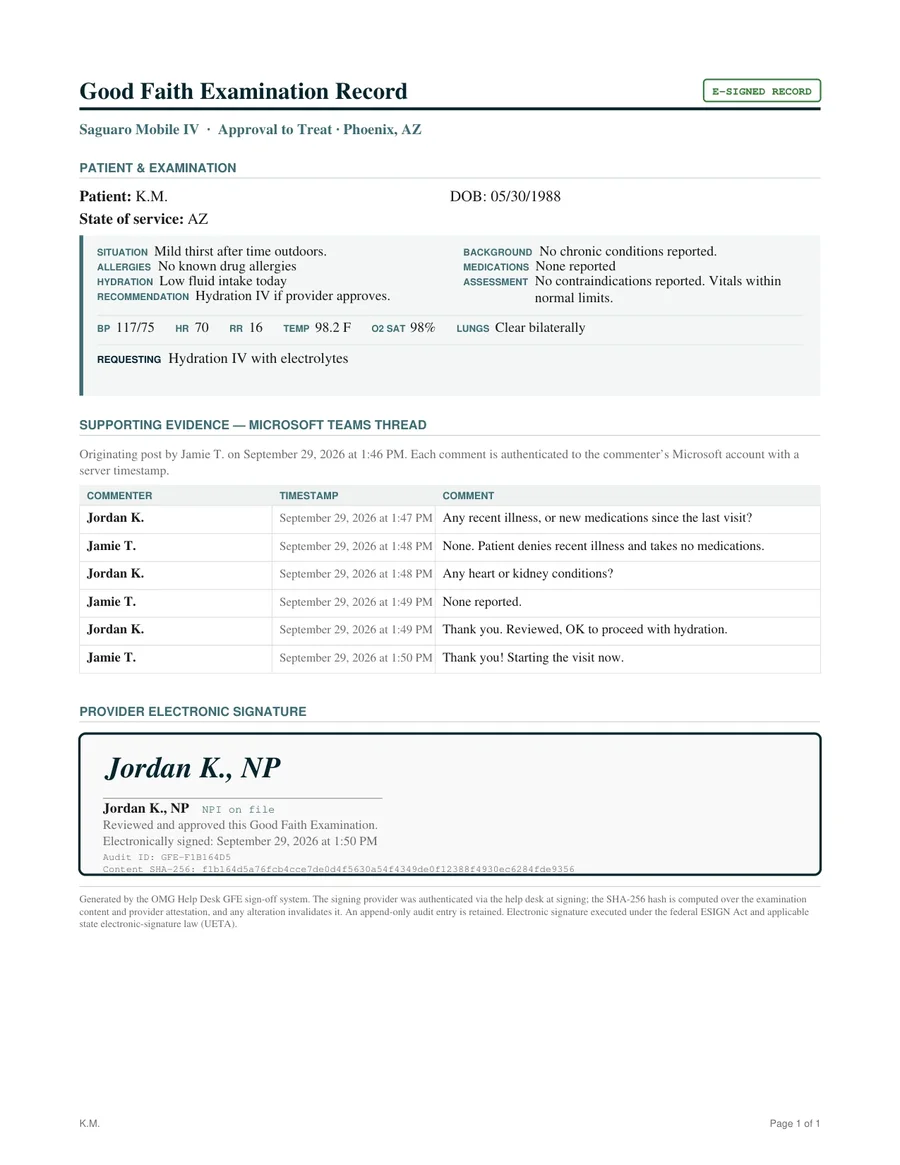
How long you must keep medical records is set by your state. Ask your medical director or attorney.
Common Mistakes
- The wrong person does "the exam". An RN, esthetician or front desk fills in a form and calls it a good faith exam. California's Medical Board says the prior exam may not be delegated to registered nurses.
- Standing orders instead of an exam. A signed protocol is not an order for this patient. Oklahoma and Mississippi say standing orders are not a substitute for the individual order and history and physical. Per AmSpa, Alabama's ruling found they do not meet the physician's duty to the patient.
- A medical director on paper only. California's Medical Board warns against physicians who lend their license to a business without really supervising.
- No new exam when things change. A new drip, a new add-on, a new diagnosis or a year gone by all call for a fresh look.
- A provider licensed in the wrong state. Telehealth follows the patient's location.
- Telehealth consent never recorded in states that require it.
- A checkbox for a chart. "Cleared" with no history, findings or order behind it will not hold up.
Medical Direction, Standing Orders and the Exam
These three get mixed up. They are different pieces, and you need all of them.
| Piece | Who | What it covers |
|---|---|---|
| Medical director | A physician who oversees the medical side | Supervision, protocols and who is responsible for patient care. Not a name on paper. |
| Standing orders and protocols | Written, signed and dated by a prescriber | The set situations in which your nurses may act, and what they may do. They do not diagnose anyone. |
| Good faith exam | A physician, NP or PA | One patient, one treatment plan: is it safe and right for this person, today. |
The North Carolina Board of Nursing explains standing orders well: they are a prescriber's signed instructions for set situations, they are not driven by any one client, and they never let a nurse make a diagnosis (NC Board of Nursing). The good faith exam is the patient-specific step that sits on top of them.
Think of it this way: the medical director and the standing orders are the rulebook. The good faith exam is the call made for each patient. To set up the first part, read how to find a medical director for your IV therapy business.
How OMG Marketing Fits
OMG Marketing does not perform good faith exams and does not practice medicine. We connect IV therapy and med spa owners with an independent partner medical team, and we coordinate it so the exam fits into your nurses' day.
- Live and online. The partner team's nurse practitioners do the exam online, with the patient and your nurse, while the nurse is there.
- Fast. The typical time from request to clearance is 2 minutes. That is the median from our client portal over the last 12 months, read on Oct 14, 2026.
- Where. The partner team covers 12 states: California, Georgia, Arizona, Utah, Colorado, Nevada, New Mexico, Montana, New York, North Carolina, South Carolina and Tennessee.
- On the record. Each exam is kept as its own record, ready to attach to the chart.
See how it works: good faith exams for IV therapy and med spas. And when you are ready to fill the calendar those exams protect, see how we market mobile IV businesses.
Frequently Asked Questions
What is a good faith exam?
A good faith exam is a medical evaluation by a licensed prescriber, such as a physician, nurse practitioner or physician assistant, before a patient's first treatment. The provider reviews the patient's health history, examines them and decides whether the treatment is safe and right for them. If it is, the provider writes the order the nurse follows.
Do you need a good faith exam for IV hydration?
In the states whose rules we read, yes. The nursing boards in North Carolina, Oklahoma and Mississippi say a nurse needs an individual order from a prescriber, based on an assessment of that patient, before giving IV fluids. Mississippi says this includes plain IV fluids. Check your own state's medical and nursing boards.
Can a registered nurse do a good faith exam?
No. A registered nurse can collect the health history and vital signs, and give the treatment once it is ordered. The exam and the order must come from a physician, nurse practitioner or physician assistant, as your state allows.
Can a good faith exam be done by telehealth?
In many states, yes. California allows it by telehealth, even without a live call, if the standard of care is met. Oklahoma allows the first evaluation face to face or by telemedicine. The provider must be licensed in the patient's state, and some states require the patient's consent to telehealth to be recorded.
How long is a good faith exam good for?
There is no single national rule. The American Med Spa Association's rule of thumb is at least once a year, plus a new exam when the patient wants a treatment that was not in the original plan or their health changes. Your medical director's protocols and your state's rules set the exact window.
Are standing orders enough without a good faith exam?
No. Standing orders set the rules your nurses work within. The nursing boards in Oklahoma and Mississippi say they are not a substitute for an individual order and a history and physical for each patient.
Does OMG Marketing perform good faith exams?
No. OMG Marketing does not practice medicine. We connect clients with an independent partner medical team whose nurse practitioners do the exams, and we coordinate the process. The typical time from request to clearance is 2 minutes.
Sources
- American Med Spa Association: What Is Required of a Medical Spa's Good Faith Exams?
- American Med Spa Association: Good Faith Exams, the Medical Spa Widow-maker
- American Med Spa Association: More States Release Guidance for IV Therapy Following Alabama's Declaratory Ruling
- California Business and Professions Code section 2242 (prior examination)
- California Business and Professions Code section 2290.5 (telehealth consent)
- Medical Board of California: The Business of Medicine, Medical Spas
- Texas Legislature: House Bill 3749, enrolled text (Jenifer's Law)
- Frier Levitt: Texas Medical Spas Must Prepare for New Regulations on Elective IV Therapy
- North Carolina Board of Nursing: IV Hydration, Nutrient Therapies and Medications Position Statement
- Oklahoma Board of Nursing: IV Hydration Guidelines
- Mississippi Board of Nursing: IV Hydration Position Statement
- Center for Connected Health Policy: Cross-State Licensing
Medical services, including medical direction, protocols and good faith exams, are provided by independent licensed providers, not by OMG Marketing. OMG Marketing does not practice medicine. This guide is general information, not legal or medical advice.